


Bactekiller Inorganic Antibacterial Agent

Bactekiller: The Inorganic Antibacterial Agent That Protects Everyday Life
It effectively suppresses bacteria, mold, and viral activity encountered in everyday life, helping create a comfortable and pleasant living environment. We also offer application-ready compounds containing stabilizers and other additives, enabling a wide variety of materials to deliver antibacterial and antifungal performance.
Features
1) Outstanding Antibacterial and Antifungal Performance
Bactekiller derives its effectiveness from antibacterial metal ions contained in its ceramic carrier. When incorporated into PE, PS, PP, ABS, PET, PA, and other materials, it inhibits bacteria and mold and helps prevent slime formation, microbial deterioration, and unpleasant odors.
2) Excellent Heat Resistance
Because Bactekiller is composed of inorganic materials, its structure remains unaffected even at temperatures above 500°C. It can therefore be used extensively in thermoplastic and thermosetting resins.
3) Proven Safety
Bactekiller contains no harmful heavy metals. Its safety has been confirmed through tests on the active substance, including acute oral toxicity, primary skin irritation, and mutagenicity.
4) Long-Lasting Antibacterial and Antifungal Performance
The antibacterial metal ions are stably incorporated in Bactekiller’s ceramic carrier, so they are scarcely leached or volatilized. This provides long-lasting antibacterial and antifungal performance.
5) Reliability Verified Using a Proprietary Test Method
The inherent antibacterial properties of molded products containing Bactekiller were evaluated together with environmental discoloration resistance using our proprietary test method, confirming reliable performance in practical applications.
Antibacterial Mechanism
Silver ionsattack
structures in microbial proteins, including disulfide bonds (-S-S-), hydrogen bonds, and thiol groups (-SH),
causing them to break down and denature. This damages the microbial cell membrane and impairs metabolic function through enzyme inactivation,
thereby inhibiting microbial proliferation.
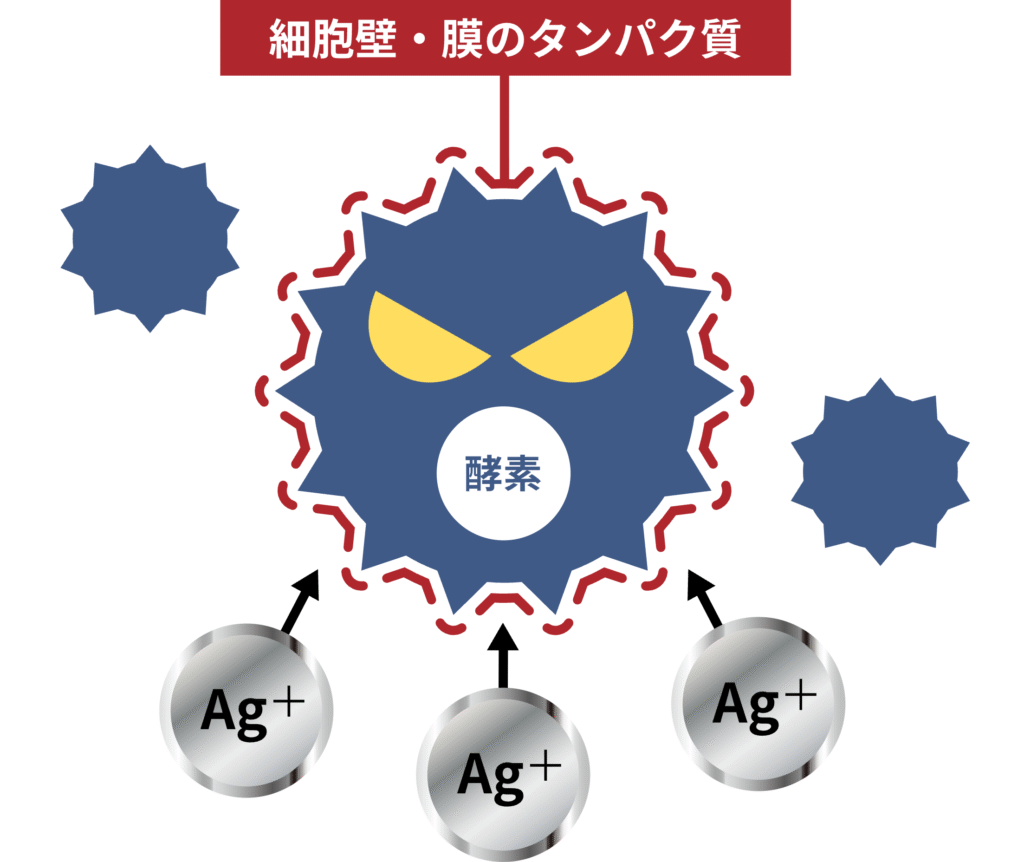
Silver ions damage the cell wall
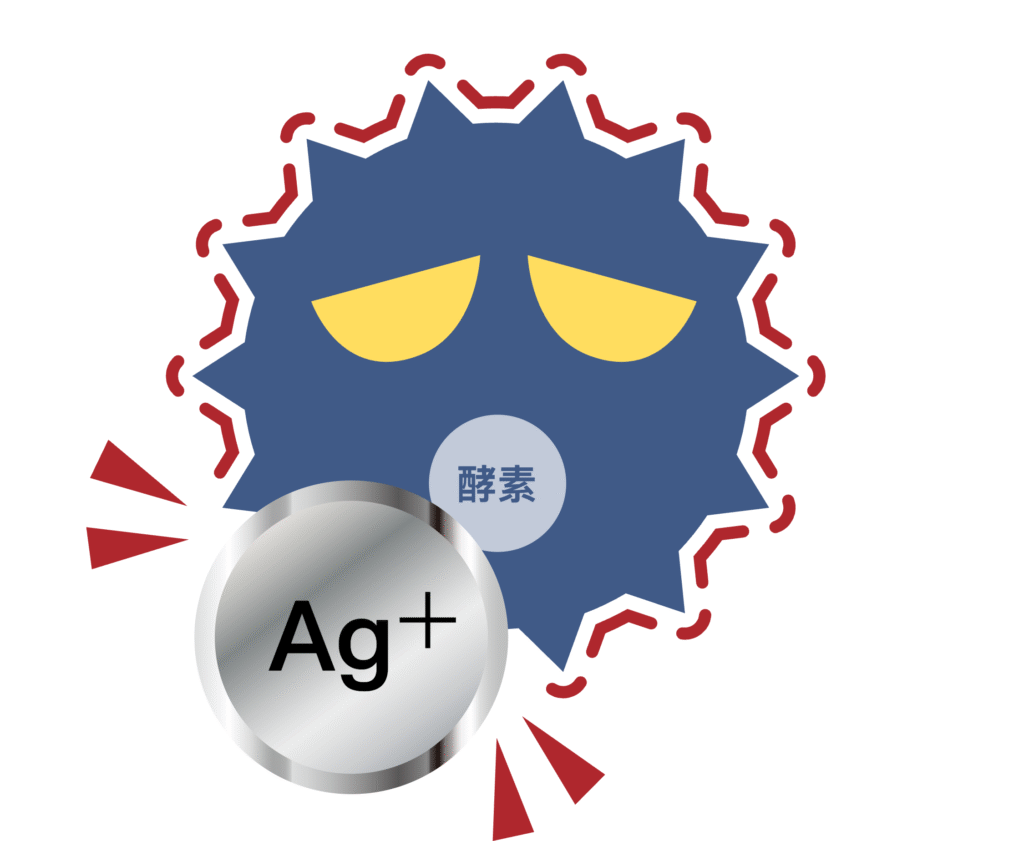
Enzyme activity is inhibited

Microbial proliferation is suppressed
Antibacterial Performance of Bactekiller (Minimum Inhibitory Concentration: MIC)
|
Microorganism (Common Name)
|
Characteristics
|
Bactekiller MIC
(Unit: ppm)
|
|
| Gram-positive bacteria | Bacillus cereus Bacillus cereus |
Widely distributed as a saprophyte; a spore-forming bacterium that decomposes plant matter | 125 |
| Bacillus subtilis Bacillus subtilis |
Widely distributed as a saprophyte; a spore-forming bacterium that decomposes plant matter | 250 | |
| Staphylococcus aureus Staphylococcus aureus |
A pathogen that causes food poisoning and suppurative infections | 250 | |
| MRSA Methicillin-resistant Staphylococcus aureus (MRSA) |
A pathogen that causes food poisoning and suppurative infections; also associated with healthcare-associated infections | 500 | |
| Enterococcus faecalis Enterococcus |
A species of streptococcus | 125 | |
| Gram-negative bacteria | Escherichia coli Escherichia coli |
A food-contaminating organism also found in the human intestinal tract | 125 |
| Escherichia coli Escherichia coli (O157:H7 / ATCC 43888) |
Pathogenic E. coli O157 (enterohemorrhagic) | 125 | |
| Pseudomonas aeruginosa Pseudomonas aeruginosa |
A pathogen that proliferates in abrasions and burns and can cause ulceration | 125 | |
| Klebsiella pneumoniae Klebsiella pneumoniae |
Part of the normal fecal flora | 125 | |
| Molds | Aspergillus niger Aspergillus niger |
Grows on and contaminates bread and fruit | 500 |
| Penicillium citrinum Green mold |
Grows on and contaminates bread, fruit, and rice cakes | 250 | |
| Chaetomium globosum Chaetomium globosum |
A cellulose-degrading fungus | 500 | |
| Cladosporium herbarum (cladosporium mold) | A mold associated with semiconductor contamination | 500 | |
| Yeasts | Saccharomyces cerevisiae (yeast) | Used in bread making; certain yeast strains are also used to produce miso, soy sauce, alcoholic beverages, and other fermented products | 250 |
MIC:The antibacterial agent is serially diluted in phosphate buffer (1,000, 500, 250, and 125 ppm) and tested against a microbial suspension of known concentration to determine the lowest concentration at which antibacterial activity is observed (the antibacterial activity criterion).
Antibacterial Performance of Resin Products
Test method: JIS Z 2801:2000 (Antibacterial activity and efficacy of antibacterial-treated products)
|
Sample / Condition |
Escherichia coli |
Staphylococcus aureus |
|||
| Initial | After 24 h | Initial | After 24 h | ||
| No aging treatment | ABS resin sheet Bactekiller 0.5% |
1.8×10⁵ | 10 or less | 2.1×10⁵ | 10 or less |
| ABS resin (additive-free sheet) | 1.8×10⁷ | 5.5×10⁵ | |||
| Light-resistance category 1 | ABS resin sheet Bactekiller 0.5% |
10 or less | 10 or less | ||
| ABS resin (additive-free sheet) | 1.5×10⁷ | 2.2×10⁵ | |||
| Light-resistance category 2 | ABS resin sheet Bactekiller 0.5% |
2.1×10 | 3.2×10 | ||
| ABS resin (additive-free sheet) | 1.4×10⁷ | 3.3×10⁵ | |||
| Control | 8.1×10⁶ | 4.1×10⁶ | |||
| No aging treatment | PP resin sheet Bactekiller 0.5% |
3.1×10⁵ | 10 or less | 4.1×10⁵ | 10 or less |
| PP resin (additive-free sheet) | 7.3×10⁶ | 5.1×10⁵ | |||
| Light-resistance category 1 | PP resin sheet Bactekiller 0.5% |
10 or less | 10 or less | ||
| PP resin (additive-free sheet) | 5.1×10⁶ | 2.9×10⁵ | |||
| Light-resistance category 2 | PP resin sheet Bactekiller 0.5% |
2.9×10 | 4.2×10 | ||
| PP resin (additive-free sheet) | 6.1×10⁶ | 4.3×10⁶ | |||
| Control | 8.1×10⁶ | 5.1×10⁶ | |||
Control: The microbial suspension was placed in a dish, covered with film, and stored.
Light-resistance category 1: xenon lamp exposure × 10 h; water-resistance category 2: 50°C × 16 h.
Grades and Applications
Powder
| Product No. | Type | Average Particle Size | Dosage | Applications | |
| General-purpose grade | BM-101A | Ag-Cu zeolite | 2 μm | 10 kg | For water treatment and preservation |
| BM-102A | Ag-Zn zeolite | 2 μm | 10 kg | For water treatment and cement | |
| BM-103A | Ag-Zn zeolite | 2 μm | 10 kg | ||
| Modified grade | BM-502CB4 | Ag-Zn ceramic series | 5 μm | 10 kg | For olefin, styrene, and ester resins |
| BM-502CB5 | Ag-Zn ceramic series | 5 μm | 10 kg | For transparent olefin, styrene, and ester resins | |
| BM-502CB6 | Ag-Zn ceramic series | 5 μm | 10 kg | ||
| BM-102CB7 | Ag-Zn ceramic series | 5 μm | 10 kg | ||
| BM-102TG | Ag-Zn ceramic series | 5 μm | 10 kg | ||
| BM-102CB9 | Ag ceramic series | 2 μm | 10 kg | For nylon, melamine, and urea resins | |
| BM-102NSC | Ag-Zn ceramic series | 2 μm | 10 kg | For unsaturated polyester and nylon resins | |
| BM-102P | Ag ceramic series | 2 μm | 10 kg | For elastomers, rubber, and rigid PVC resin | |
| BM-102S5A | Ag ceramic series | 2 μm | 10 kg | For flexible PVC resin | |
| TZA-125CS5C | Inorganic-organic hybrid type | 2 μm | 4 kg |
Masterbatch
| Compatible Resin | Product Name | Bactekiller Content (wt%) | MI Value | Net Weight |
| PP | OM-DJ110 | 4 | 20 | 20 kg / PE inner bag |
| PE | OM-AJ203 | 15 | 2 | 20 kg / PE inner bag |
| PET | FK-43 | 10 | 20 kg / PE inner bag | |
| PET | FK-59 | 20 | 20 kg / PE inner bag | |
| PET | FK-67 | 20 | 20 kg / PE inner bag | |
| PA | NY-10KB(KAI) | 10 | 20 kg / PE inner bag | |
| PA | NY-10KC | 10 | 20 kg / PE inner bag |
In addition to the grades listed above, we can recommend a more suitable grade based on your performance requirements.