


Sanyo Chemical PELESTAT Permanent Antistatic Agent (General-Purpose Type)
Complete Lineup for a Wide Range of Resins and Molding Methods
When added to various resins such as ABS, PP, and PE, it rapidly provides antistatic performance and prevents static-electricity-related problems over the long term.
Advantages
Complete Lineup for a Wide Range of Resins and Molding Methods
Adding it to resins such as ABS, PP, and PE quickly imparts antistatic performance and provides semi-permanent protection against damage caused by static electricity.
Low Contamination
Because PELESTAT is an ion-conductive polymer, it does not contaminate resin surfaces through antistatic-agent blooming.
Maintains the Mechanical Properties of the Resin
Minimizes the effect on the hardness and heat resistance of the plastic to which it is added. It imparts antistatic performance with almost no reduction in the resin’s mechanical properties.
Applications
Vacuum-Cleaner Dust Container
Base Resin: Transparent ABS (Injection Molding)
Adding an antistatic agent to the transparent dust container suppresses dust adhesion caused by static charge accumulating on the resin surface while maintaining transparency and visibility.

Refrigerator Components
Base Resin: PP (Injection Molding)
Prevents staining around refrigerator feet caused by dust accumulated on the floor.

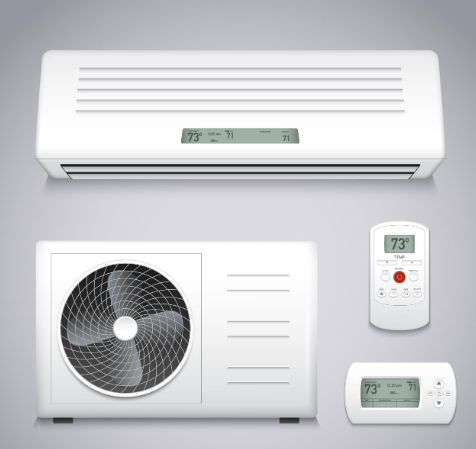
Front Covers for Air Conditioners and Air Purifiers
Base Resin: HIPS (Injection Molding)
Prevents staining caused by dust adhesion.
Medical Devices (Inhalers)
Helps prevent inhaled powder from adhering to the inner wall of the inhaler due to static electricity, allowing the prescribed dose to be drawn correctly.

Explosion-Proof Helmets
Base Resin: PP (Injection Molding)
By suppressing the generation of electrostatic sparks, PELESTAT is also used for explosion-proof applications in resin products.

Features
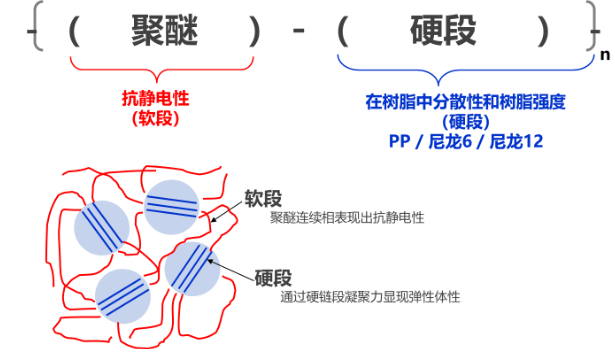
Good Dispersibility
In addition to imparting antistatic performance, it causes almost no reduction in the mechanical properties or moldability of plastics.
Advantages over Carbon-Black Conductive Materials
Compared with carbon-black conductive materials, it offers advantages in uniform antistatic performance, low dust generation, impact resistance, and color flexibility.
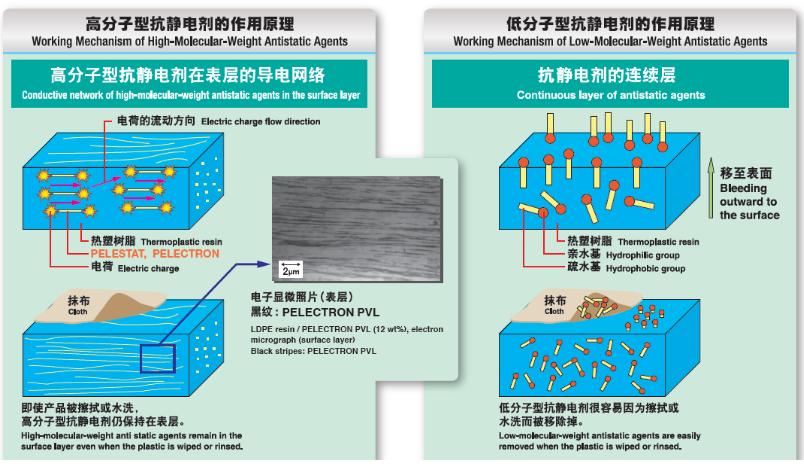
Advantages over Low-Molecular-Weight Antistatic Agents
Compared with low-molecular-weight antistatic agents, it offers long-lasting antistatic performance, independence from humidity, and immediate effectiveness after molding.
Technical Support for Various Processing Methods
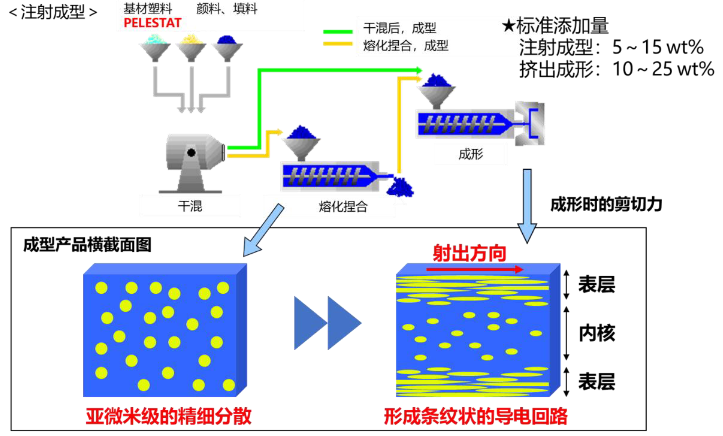
Compatible with many molding methods, including injection molding and extrusion. Drawing on extensive practical experience, we provide expert technical support to help ensure smooth production processes.
Comparison of PELESTAT® and PELECTRON Series Permanent Antistatic Agents with Low-Molecular-Weight Antistatic Agents
| Permanent Antistatic Agent PELESTAT and PELECTRON | Low-Molecular-Weight Antistatic Agent (Temporary Antistatic Agent) | |
|---|---|---|
| Surface Resistivity (Ω/sq.) | 108~1012 | 109~1012 |
| Required Addition Level (wt%) | 5~25 | 0.2~2 |
| Durability of Antistatic Effect | ○ (Durable) | × (Not Durable) |
| Effect of Humidity on Antistatic Performance | ○ (Not Affected by Humidity) | × (Performance Declines at Low Humidity) |
| Antistatic Performance after Resin Molding | ○ (Effective Immediately after Molding) | × (Requires Time to Become Effective) |
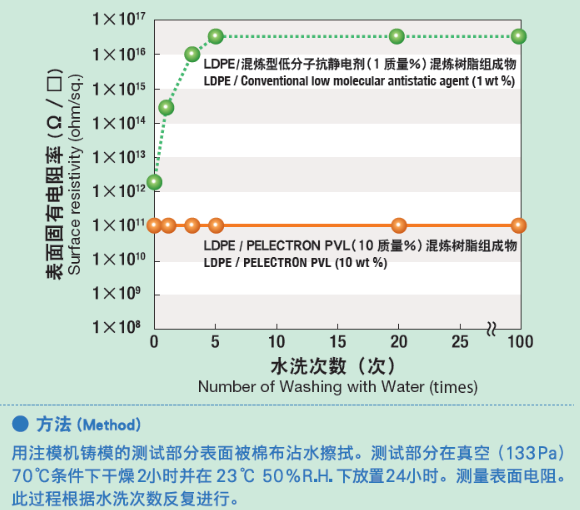
Example Evaluation of Antistatic Durability
The surface resistivity of LDPE containing a temporary antistatic agent increases after washing with water, whereas that of LDPE containing a permanent antistatic agent remains unchanged even after washing.
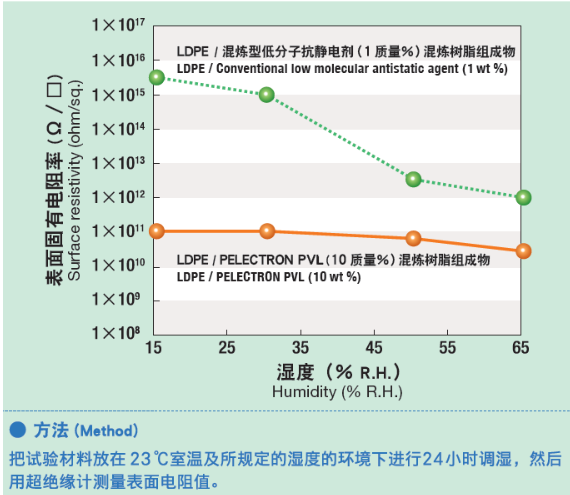
Example Evaluation of the Effect of Humidity on Antistatic Performance
The surface resistivity of LDPE containing a temporary antistatic agent increases at low humidity, whereas the surface resistivity of LDPE containing a permanent antistatic agent does not vary with humidity.
Example Evaluation of the Effect of Humidity on Antistatic Performance
| Permanent Antistatic Agent PELESTAT® and PELECTRON | Carbon Black | Carbon Fiber | |
|---|---|---|---|
| Conduction Type | Ionic Conduction | Electronic Conduction | Electronic Conduction |
| Surface Resistivity (Ω/sq.) | ~109 | ~106 | ~106 |
| Resistance Uniformity | ◎ | △ | × |
| Dust Generation | ◎ | × | △ |
| Rigidity (Flexural Modulus) | △ | ○ | ◎ |
| Impact Resistance | ◎ | × | △ |
| Color Options | Unrestricted | Black Only | Black Only |
Grades
| PELESTAT 300 | PELESTAT 230 | PELESTAT LM230 (Development Grade) | PELECTRON PVL | PELESTAT NC6321 | PELESTAT 6500 | PELESTAT 6200 | PELECTRON AS | |
|---|---|---|---|---|---|---|---|---|
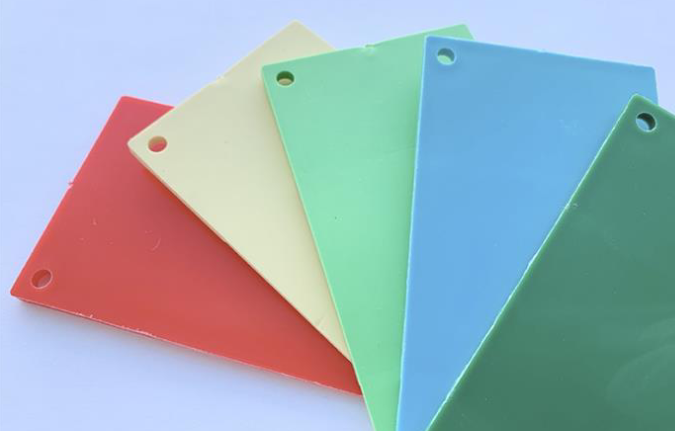
| Appearance | Pale Yellow Round Pellets | Pale Yellow Round Pellets | Pale Yellow Round Pellets | Pale Yellow Round Pellets | Pale Yellow Round Pellets | Pale Yellow Round Pellets | Pale Yellow Round Pellets | Pale Yellow Round Pellets |
| Melting Point (°C) | 135 | 163 | 115 | 135 | 203 | 191 | 193 | 195 |
| MFR(g/min) | 30 (190℃ 21.18N) | 10 (190℃、21.18N) | 15 (190℃ 21.18N) | 15 (190℃ 21.18N) | 20 (215℃ 21.18N) | 20 (215℃ 21.18N) | 30 (215℃ 21.18N) | 30 (215℃ 21.18N) |
| Refractive Index | 1.495 | 1.495 | 1.495 | 1.495 | 1.515 | 1.515 | 1.510 | 1.510 |
| Onset Temperature of Thermal Decomposition*1 (°C) | 240 | 250 | 250 | 250 | 285 | 285 | 285 | 285 |
| Surface Resistivity*2 (Ω/□) | 1×10⁸ | 5×10⁷ | 5×10⁷ | 3×10⁶ | 1×10⁹ | 1×10⁸ | 1×10⁸ | 4×10⁶ |
| Applicable Resins | PP、PE (Injection Molding) | PP、PE (Extrusion Molding) | PP、PE (Extrusion Molding) | PP、PE (Extrusion Molding) | ABS, Transparent ABS, PC/ABS、PBT | ABS, Transparent ABS, PC/ABS、PBT | ABS、PC/ABS、 PBT | ABS、PC/ABS、 PBT |
| Features | Low Melting Point | Low Resistance | Low Ionic Contamination | Low Ionic Contamination | Low Resistance | |||
| Controllable Surface-Resistance Range of Molded Products Containing This Product (Ω/□) | 1010~1012 | 1010~1012 | 1010~1012 | 108~1012 | 1011~1012 | 1010~1012 | 1010~1012 | 108~1012 |
|
*1 TG-DTA in Air *2 PELESTAT® and PELECTRON were molded alone, conditioned for 24 hours at 23°C and 50% RH, and their surface resistivity was measured with an ultra-high-resistance meter. | ||||||||
Test Examples
PELESTAT® 230 (General-Purpose Type) and PELECTRON PVL (Low-Resistance Type)
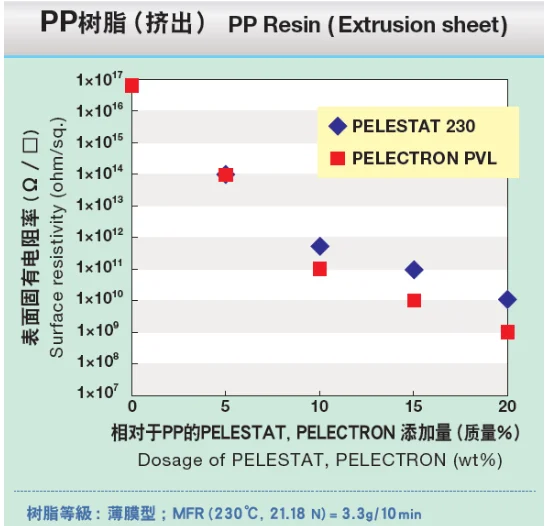
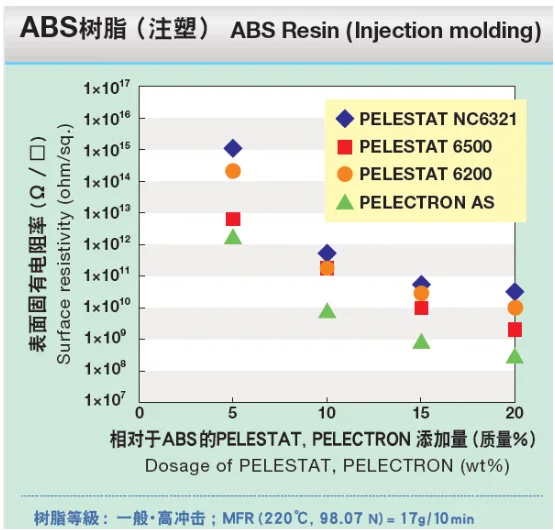
Addition Data for ABS Resin (Injection Molding): PELESTAT®NC6321 (General-Purpose Type), PELESTAT®6500 (General-Purpose Type), and PELECTRON AS (Low-Resistance Type)
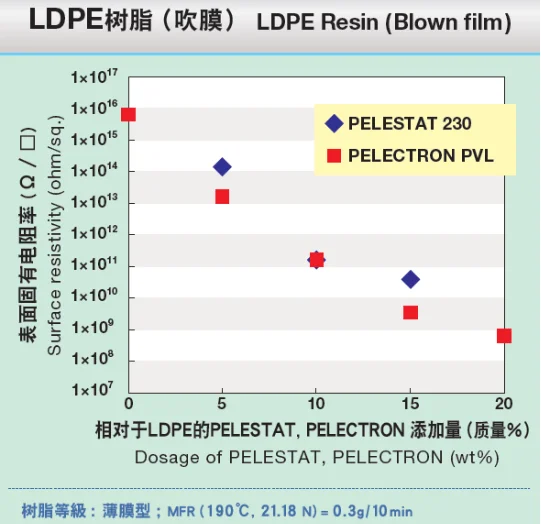
Addition Data for LDPE Resin (Blown-Film Molding): PELESTAT® 230 (General-Purpose Type) and PELECTRON PVL (Low-Resistance Type)
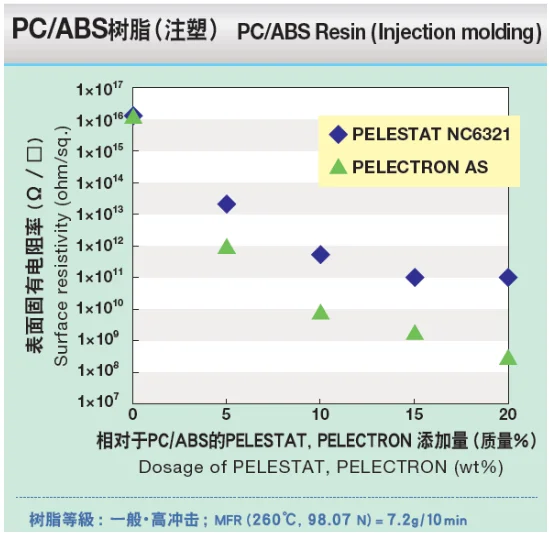
Addition Data for PC/ABS Resin (Injection Molding): PELESTAT®NC6321 (General-Purpose Type) and PELECTRON AS (Low-Resistance Type)
Other Fine-Chemical Products
- SR-D50F Anti-Dripping Agent
- Thermally Degraded Polyethylene Wax
- PEL Conductive Functional Additive