


Natural Bamboo-Based Antibacterial Deodorizing Agent
Shirai Matsu Shinyaku Co., Ltd.
Traditional foods such as zongzi, sasa dango, and akumaki have long been wrapped in bamboo sheaths or leaves to take advantage of bamboo’s preservative and antibacterial properties. Building on this time-tested knowledge and the identification of bamboo’s active constituents, this product uses an improved dry-distillation extraction process to produce a highly effective antibacterial agent.
Grades
| Product Grade | Packaging | Composition | Form | Applications | Example Applications |
|---|---|---|---|---|---|
| NB-390 | 20 kg / 200 kg | Moso bamboo extract, PG, water, and other ingredients | Liquid | Alcohol-Free Applications | Cosmetics, foods, household products, and more |
| NB-395 | 15 kg | Moso bamboo extract, PG, ethanol, surfactant, water, and other ingredients | Liquid | Nonaqueous Applications |
Safety
Antibacterial Efficacy
Minimum Inhibitory Concentration (MIC) Test Using Standard Agar Medium
The polyphenols in bamboo extract provide powerful antibacterial activity against a wide range of microorganisms.
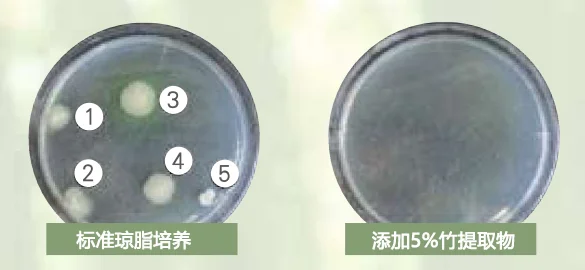
Testing at a 5% concentration in standard agar medium confirmed antibacterial activity against bacteria and fungi.
| No. | Microbial Strain | Dosage (%) |
|---|---|---|
| 1 | Escherichia coli (E. coli) | 2.5 |
| 2 | Bacillus subtilis (Hay bacillus) | 2.5 |
| 3 | Staphylococcus aureus (S. aureus) | 2.5 |
| 4 | Saccharomyces cerevisiae (Baker's yeast) | 2.5 |
| 5 | Aspergillus niger (Black aspergillus) | 5.0 |
Preservative Effect
Adding the natural bamboo deodorizing agent makes it possible to formulate products without preservatives.
The figure below shows the results of the preservation-performance test.
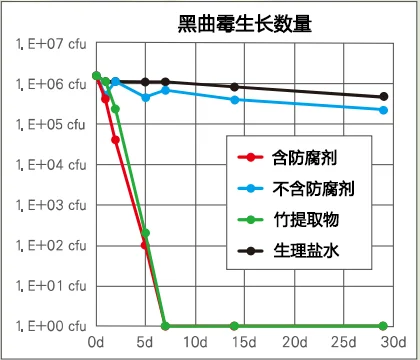
The conventional product (red: with preservative) showed adequate preservative performance. Removing the preservative (blue: preservative-free) reduced performance to a level comparable with physiological saline (black). Adding bamboo dry-distillation extract to the preservative-free product (green: 1.5%) restored preservative performance to the same level as the preservative-containing product.
* The dosage required for a preservative-free formulation varies with the formulation and may need adjustment.
Deodorizing Performance
Test materials: ● Bamboo extract ● Purified water or buffer solution (control)
Malodor sources: ● Ammonia and trimethylamine ● Methyl mercaptan and hydrogen sulfide
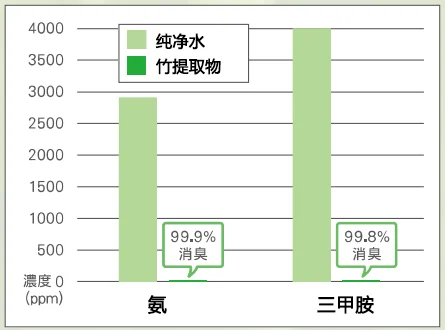
For the ammonia and trimethylamine deodorizing tests, each test material was placed in a sealed container. After adding the malodor, its concentration in the container was measured with detector tubes.
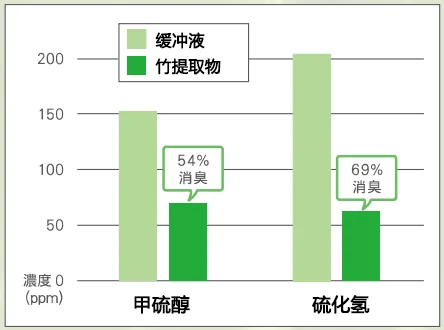
For the methyl mercaptan and hydrogen sulfide deodorizing tests, bamboo extract diluted with buffer solution was used to prevent the liquid state from slowing the reaction. Each test material was placed in a sealed container, the malodor was added, and its concentration in the container was measured by GC-FPD.