


PEL Conductive Functional Additive
PEL is an ion-conductive functional additive produced by combining a polyglycol-based polymer, primarily PAG, with salts such as lithium perchlorate.
Based on compatibility with various resins, the product line consists of several grades centered on PEL-20A and is used in a variety of polyurethane products.
| Product Name |
Ion-Conductive Polymer PEL ① PEL-20A ② PEL-100 ③ PEL-25 ④ PEL-46 |
| Chemical Name / Main Components and Structure | ① PEL-20A
Salt Content: Lithium Perchlorate (10%), PEO-PPO 90%② PEL-100
Salt Content: Lithium Perchlorate (10%), PPO 90%③ PEL-25
Salt Content: Lithium Perchlorate (10%), PEO-PPO 85%④ PEL-46
Salt Content: Lithium Salt of Organic Boron Complex (30%), PEO-PPO 70% |
| Form | Solids, liquids, gases, powders, bulk materials, modified compounds, resin pellets, slurries, and others |
| Primary Application | Semiconductors, memory chips, power electronics, printed circuit boards, circuit wiring, grids, power supplies, connectors, encapsulants, bonding materials, communications, wireless equipment, sensors, motors, drive components, in-vehicle electronics, generators, batteries, lithium batteries, solar cells, fuel cells, renewable-energy equipment, optical equipment, lenses, processing light sources, laser equipment, lighting equipment, displays, recording materials, fiber-optic peripheral equipment, and other applications such as electronic packaging materials |
| Regulatory Standards Licensing Information |
Principle of PEL Ionic Conduction
Normally, perchlorate salts such as lithium perchlorate exist as solid salts with their anions and cations bound together under anhydrous conditions or in the presence of solvents, and they do not exhibit ionic conductivity when directly mixed into polymers.
In PEL, the cations of salts such as lithium perchlorate are first dissociated through solvation by ether oxygen atoms in the polyglycol (PAG).
The dissociated ions become mobile through molecular vibration of the polyglycol (PAG) and move toward the corresponding electrodes under an external electric field, generating ionic conductivity.
Unlike conductive additives based on quaternary-ammonium surfactants, this mechanism does not require moisture from the air for ionic conduction and therefore maintains conductivity even at low humidity.
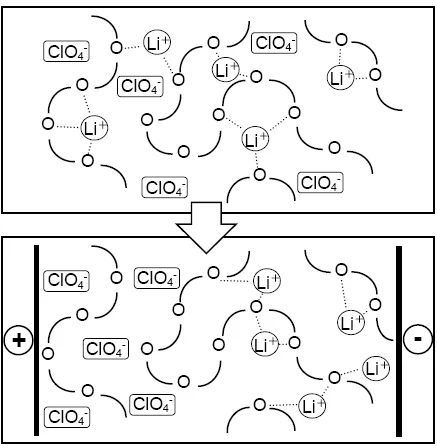
Conceptual Diagram of PEL Ionic Conduction
Grades
| Test Item | PEL-20A | PEL-100 | PEL-25 | PEL-46 |
|---|---|---|---|---|
| Appearance | Clear to Pale Yellow | Clear to Pale Yellow | Clear to Pale Yellow | Pale Yellow |
| Form | Liquid | Liquid | Liquid | Liquid |
| Salt | Lithium Perchlorate | Lithium Perchlorate | Lithium Perchlorate Lithium Triflate | Lithium Salt of Organic Boron Complex |
| Salt Content | 10wt% | 10wt% | 15wt% | 30wt% |
| Main Polymer Component | PEO-PPO Copolymer | PPO | PEO-PPO Copolymer | PEO-PPO Copolymer |
| Polymer Molecular Weight | Approx. 1,300 | Approx. 2,000 | Approx. 1,300 | Approx. 1,300 |
| OH Value | Approx. 78 | Approx. 57 | Approx. 74 | Approx. 58 |
| Features | High Conductivity | Improved Compatibility with Hydrophobic Resins | Higher Conductivity than PEL-20A | Halogen-Ion-Free and Low Mobility |
Application Examples
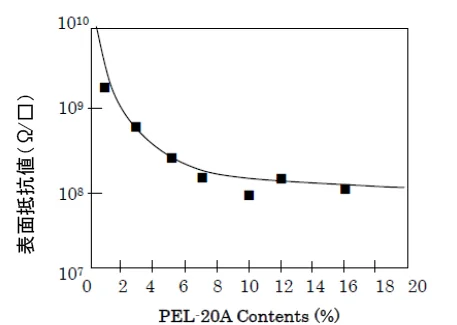
Adding 10% to Polyurethane PEL-20Aachieves surface resistivity on the order of 109Ω/□
Surface resistivity at various humidity levels after films were formed using different PEL conductive additives and an isocyanate cross-linking agent.Stable antistatic performance is maintained over a wide range of humidity conditions.
Resin Compatibility
| Polyurethane and Acrylic Resins | ○ |
| Polyester, Epoxy, and Polyvinyl Chloride Resins | △ |
| Hydrocarbon Resins such as PE, PP, and PS | △ or × |
| PVDF | × |
| Silicone Resins and Styrene-Acrylic Resins | × |
Precautions
PEL is manufactured and sold under conditions designed to maximize safety. During use and storage, keep it away from flammable environments.
Do not heat PEL above the decomposition temperature of the compounded polymer, and avoid contact with reducing substances.
Refer to the SDS before use and contact us with any questions.
Other Fine-Chemical Products
- SR-D50F Anti-Dripping Agent
- Thermally Degraded Polyethylene Wax
- PEL Conductive Functional Additive