


Zirconia Substrates
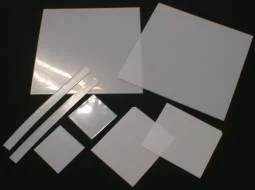
Zirconia (ZrO2) provides excellent corrosion and heat resistance. Compared with alumina (Al2O3), it also offers superior toughness and flexural strength.
These substrates can be used in products requiring precision dimensional machining, including optical communication equipment, ceramic cutting tools, and pulverizers. As a solid oxide electrolyte, zirconia can also be used in exhaust-gas sensors.
Features
•Excellent heat resistance
• Excellent corrosion resistance
• High toughness
• High strength
• Excellent surface smoothness
• Excellent wear resistance
Applications
• Mechanical components
• Ceramic cutting tools
• Optical communication equipment
• Exhaust-gas sensors
• Various thin electronic components
Physical Properties
| Material Name | Zirconia | Unit | |
|---|---|---|---|
| Grade | KZ-3 (Machine Components and Cutting Tools) | KZ-8 (Sensor Components) | |
| Purity |
ZrO2:94% Y2O3:6% |
ZrO2:87% Y2O3:13% | % |
| Water Absorption | 0 | 0 | % |
| Specific Gravity | 6 | 5.85 | g/cm³ |
| Surface Roughness | 1 | 1 | μRmax |
| Hardness (HV) | 14.0 | 11.3 | GPa |
| Coefficient of Linear Expansion (40–800°C) | 11.2 | 10 | 10-6/℃ |
| Thermal Conductivity | 3.0 | 3.0 | W/(m·K) |
| Flexural Strength | 980 | 735 | MPa |
| Withstand Voltage | - | - | kV/mm |
| Volume Resistivity | 1012or Higher | 1012or Higher | Ω·cm |
| Relative Permittivity | 30 | 25 | (1MHz) |
| Dielectric Loss Tangent | 17 | 16 | 10-4 |
| Dielectric Loss | 4×10⁻³or Lower | 4×10⁻³or Lower | (1MHz) |