


Microhole Machining (Various Nozzles)
Sanyo Seiki Co., Ltd. specializes in microhole machining for synthetic-fiber spinnerets, hollow-fiber nozzles, ultrahigh-pressure (200 MPa) cleaning nozzles, special medical nozzles, and a wide variety of industrial jets and nozzles.
Minimum Hole Diameter: 70 μm and Above
Aspect Ratio (L/D) = 10; machinable materials: titanium, stainless steel, ceramics, glass, and common metals
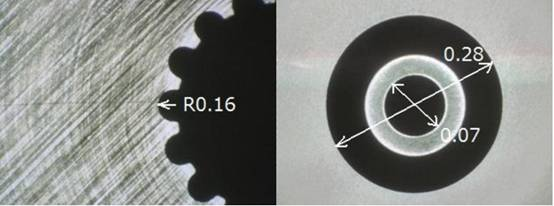
As industries advance, demand for micron-scale precision machining continues to grow.
For difficult-to-machine materials such as titanium, stainless steel, ceramics, and glass, we use fine, precise machining technology to manufacture products that meet customer requirements.
Melt-Spinning Speed Reaches 600 km/h—10,000 Times the Speed of Silkworm Spinning
In one sense, the history of fiber technology is the history of ever-increasing spinning speeds. In the 1960s, polyester filament spinning first reached 1,000 m/min, ushering in the era of high-speed melt spinning. Today, spinning speeds exceed 7,000 m/min.
Some fibers are now spun at speeds comparable to a jet aircraft. A silkworm spins at no more than 1 m/min, while industrial spinning has reached an astonishing 10,000 times that speed.
Higher spinning speeds not only increase output per unit of time; they also allow the fiber structure to be completed without drawing, as molecular orientation along the fiber axis crystallizes. This structure gives the fibers physical properties and textures very different from those produced by low-speed spinning and supports new synthetic-fiber technologies.
Machining Example 1
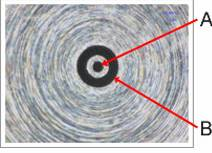
Dimension A: Φ70 μm
Dimension B: Φ200 μm
Dimensions A and B, Tolerance: ±10 μm
Holes A and B, Coaxiality: ±2 μm
Machining Example 2
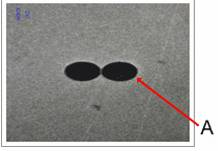
Dimension A: Φ200 μm; Tolerance: ±10 μm
Hole A Positional Accuracy: 5 μm
Machining Example 3
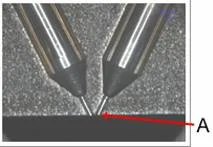
Cross-Sectional Photograph of Hole A