

Titanates and Silicates — Nippon Chemical Industrial Titanium Division
Features
1. Our products focus primarily on titanates and silicates.
2. The particle size and shape of titanates and silicates can be controlled. Calcium titanate in particular offers a wide adjustment range.
3. Titanates and silicates can receive various surface treatments, including hydrophobic and hydrophilic treatments.
Applications
■ Resin fillers ■ Electronic components ■ Cosmetic ingredients ■ White pigments
■ Copiers and printers ■ Ceramic capacitors ■ Biocompatible ceramic materials ■ Photocatalysts
Application Example
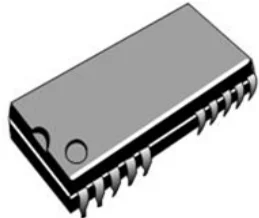
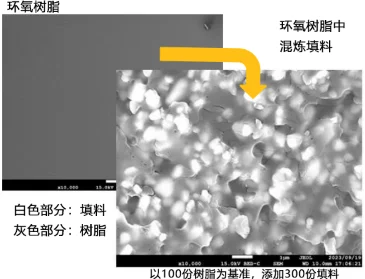
Inorganic composite oxides are used to adjust the dielectric constant of semiconductor resin encapsulation materials.
Examples: Relative dielectric constants of powders
Strontium titanate: 135
Calcium titanate: 105
Magnesium titanate: 14
Magnesium silicate: 8
Grades and Specifications
| Category | Composition | Chemical Formula | Grade | Synthesis Method | Primary Particle Size (Electron-Microscope Diameter, μm) | Particle Shape | Features |
|---|---|---|---|---|---|---|---|
| Titanates | Strontium Titanate | SrTiO3 | SW-100 | Solid-Phase Method | 0.1 | Granular | High Dielectric Constant |
| SW-110 | Solid-Phase Method | 0.5 | Granular | ||||
| SW-350 | Liquid-Phase Method | 0.1 | Cubic | ||||
| Calcium Titanate | CaTiO3 | TC-110 | Solid-Phase Method | 0.1 | Granular | High Dielectric Constant | |
| TC-300 | Liquid-Phase Method | 0.3 | Granular | ||||
| TC-301 | Liquid-Phase Method | 0.5 | Granular | ||||
| TC-303 | Liquid-Phase Method | 0.7 | Granular | ||||
| TC-400 | Liquid-Phase Method | 0.5 | Rectangular | ||||
| TC-400C | Liquid-Phase Method | 0.6 | Granular | ||||
| TC-403 | Liquid-Phase Method | 0.7 | Rectangular | ||||
| TC-403C | Liquid-Phase Method | 0.8 | Granular | ||||
| TC-405 | Liquid-Phase Method | 1.2 | Rectangular | ||||
|
True-Spherical Calcium Titanate New! | CaTiO3 | TCG-110 | Solid-Phase Method | 8.0 | True Spherical | ||
| TC-109 | Solid-Phase Method | 7.0 | True Spherical | ||||
| Magnesium Titanate | MgTiO3 | TM-200 | Solid-Phase Method | 0.3 | Granular | Medium Dielectric Constant | |
| TM-203 | Solid-Phase Method | 0.8 | Granular | ||||
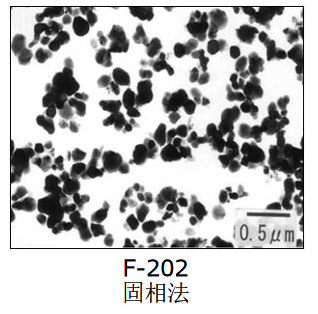
| Silicates | Magnesium Silicate | Mg2SiO4 | F-202 | Solid-Phase Method | 0.2 | Granular | Low Dielectric Constant |
Features
1. Our products focus primarily on titanates and silicates.
2. The particle size and shape of titanates and silicates can be controlled. Calcium titanate in particular offers a wide adjustment range.
3. Titanates and silicates can receive various surface treatments, including hydrophobic and hydrophilic treatments.
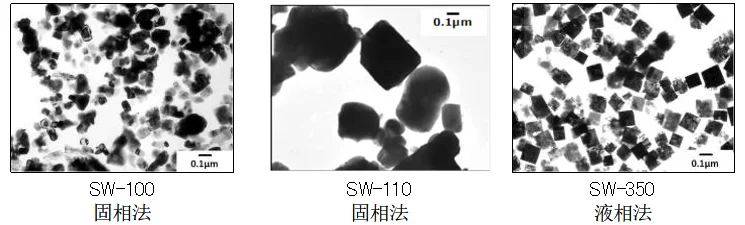
Strontium Titanate SW Series
[Features]
● High dielectric constant
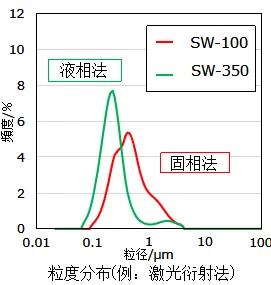
● Particle shape can be controlled by the production method
● Solid-phase method: granular
● Liquid-phase method: cubic
● Particle-size control: 0.1–0.5 μm
● Surface treatment with silane coupling agents and other materials is available
| SW-100 | Solid-Phase Method | 0.1 | 0.4 | 7.4 | 17.4 | 0.76 | 5.4 | 135 |
| SW-110 | Solid-Phase Method | 0.5 | 0.5 | 2.6 | 10.5 | 0.79 | 5.4 | − |
| SW-350 | Liquid-Phase Method | 0.1 | 0.2 | 30 | 22.0 | 0.71 | 4.8 | − |
| * Property values in the table are representative values. Relative dielectric constants were measured by the impedance method. | ||||||||
Strontium Titanate SW Series
[Features]
● High dielectric constant
● Particle shape can be controlled by the production method
● Solid-phase method: granular
● Liquid-phase method: cubic
● Particle-size control: 0.1–0.5 μm
● Surface treatment with silane coupling agents and other materials is available
| Grade | Synthesis Method | Primary Particle Size (μm) | Average Secondary Particle Size (μm) | Specific Surface Area (m²/g) | Oil Absorption (g/100g) | Circularity | Specific Gravity (g/cm³) | |
|---|---|---|---|---|---|---|---|---|
| SW-100 | Solid-Phase Method | 0.1 | 0.4 | 7.4 | 17.4 | 0.76 | 5.4 | 135 |
| SW-110 | Solid-Phase Method | 0.5 | 0.5 | 2.6 | 10.5 | 0.79 | 5.4 | − |
| SW-350 | Liquid-Phase Method | 0.1 | 0.2 | 30 | 22.0 | 0.71 | 4.8 | − |
| * Property values in the table are representative values. Relative dielectric constants were measured by the impedance method. | ||||||||
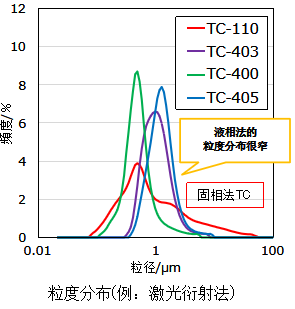
Calcium Titanate TC Series
[Features]
● High dielectric constant
● Particle shape can be controlled by the manufacturing method
● Liquid-phase method: rectangular
● Particle-size control: 0.5–1.2 μm
● Surface treatment with silane coupling agents and other materials is available
| Grade | Synthesis Method | Primary Particle Size (μm) | Average Secondary Particle Size (μm) | Specific Surface Area (m²/g) | Oil Absorption (g/100g) | Circularity | Specific Gravity (g/cm³) |
|---|---|---|---|---|---|---|---|
| TC-400 | Liquid-Phase Method | 0.5 | 0.6 | 20 | 25.2 | 0.65 | 3.8 |
| TC-403 | Liquid-Phase Method | 0.7 | 0.9 | 10 | 24.7 | 0.68 | 3.8 |
| TC-405 | Liquid-Phase Method | 1.2 | 1.3 | 30 | 21.5 | 0.69 | 3.9 |
| * Property values in the table are representative values. | |||||||
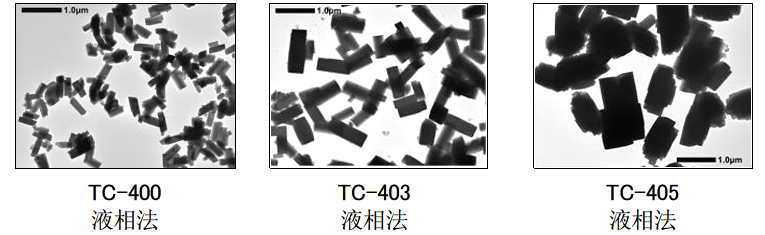
Calcium Titanate TC Series Rectangular
[Features]
● High dielectric constant
● Particle shape can be controlled by the manufacturing method
● Liquid-phase method: rectangular
● Particle-size control: 0.5–1.2 μm
● Surface treatment with silane coupling agents and other materials is available
| Grade | Synthesis Method | Primary Particle Size (μm) | Average Secondary Particle Size (μm) | Specific Surface Area (m²/g) | Oil Absorption (g/100g) | Circularity | Specific Gravity (g/cm³) |
|---|---|---|---|---|---|---|---|
| TC-400 | Liquid-Phase Method | 0.5 | 0.6 | 20 | 25.2 | 0.65 | 3.8 |
| TC-403 | Liquid-Phase Method | 0.7 | 0.9 | 10 | 24.7 | 0.68 | 3.8 |
| TC-405 | Liquid-Phase Method | 1.2 | 1.3 | 30 | 21.5 | 0.69 | 3.9 |
| * Property values in the table are representative values. | |||||||
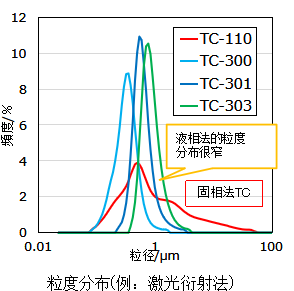
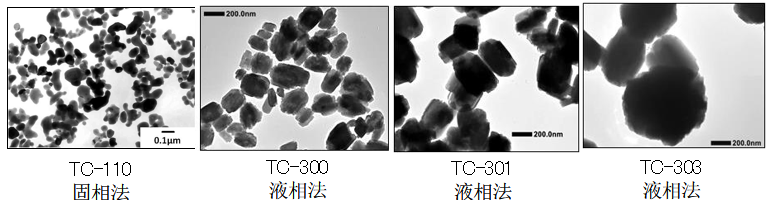
Calcium Titanate TC Series Granular
[Features]
●High Dielectric Constant
●By adding a shape-control agent, particles that are originally rectangular can be converted to a granular shape.
●Particle-size control: 0.3–0.7 μm
●Surface treatment with silane coupling agents and other materials is available.
| Grade | Synthesis Method | Primary Particle Size (μm) | Average Secondary Particle Size (μm) | Specific Surface Area (m²/g) | Oil Absorption (g/100g) | Circularity | Specific Gravity (g/cm³) | Relative Dielectric Constant (Powder) |
|---|---|---|---|---|---|---|---|---|
| TC-110 | Liquid-Phase Method | 0.1 | 0.6 | 15 | 26.1 | 0.72 | 4.0 | 105 |
| TC-300 | Liquid-Phase Method | 0.3 | 0.3 | 40 | 25.0 | 0.81 | 3.5 | — |
| TC-301 | Liquid-Phase Method | 0.5 | 0.6 | 20 | 24.7 | 0.81 | 3.5 | — |
| TC-303 | Liquid-Phase Method | 0.7 | 0.8 | 10 | 19.8 | 0.80 | 3.6 | — |
| * TC-110 is calcium titanate manufactured by the solid-phase method. Values in the table are representative values. Relative dielectric constants were measured by the impedance method. | ||||||||
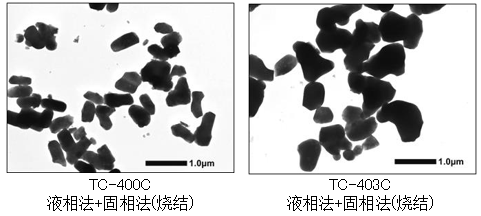
Calcium Titanate TC Series Granular, Sintered Type
[Features]
●High Dielectric Constant
●Particles synthesized by the liquid-phase method are sintered to convert their original rectangular shape into a granular shape.
●Particle-size control: 0.6–0.8 μm
●Surface treatment with silane coupling agents and other materials is available.
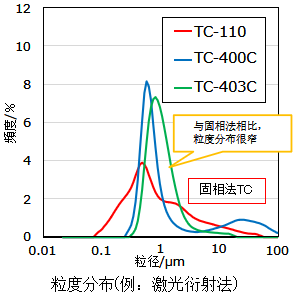
| Grade | Synthesis Method | Primary Particle Size (μm) | Average Secondary Particle Size (μm) | Specific Surface Area (m²/g) | Oil Absorption (g/100g) | Circularity | Specific Gravity (g/cm³) |
|---|---|---|---|---|---|---|---|
| TC-400C | Liquid-Phase Method | 0.1 | 0.7 | 4.7 | 16.2 | 0.80 | 3.7 |
| TC-403C | Liquid-Phase Method | 0.8 | 0.9 | 2.6 | 15.9 | 0.81 | 3.8 |
| * Property values in the table are representative values. | |||||||
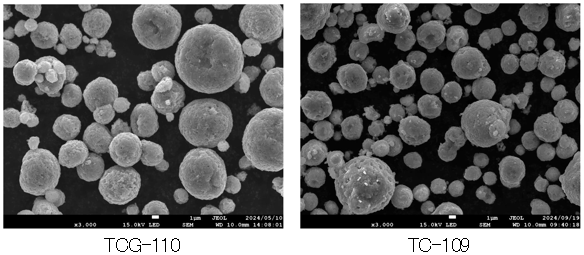
Calcium Titanate TCG/TC Series True Spherical
[Features]
●High Dielectric Constant
●True-spherical particle shape
●Particle-size control: 5–10 μm
●Surface treatment with silane coupling agents and other materials is available.
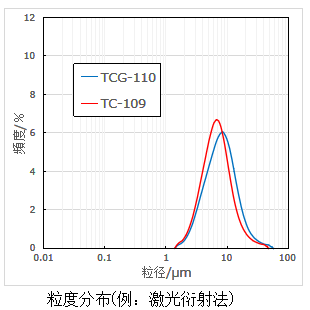
| Grade | Synthesis Method | Average Secondary Particle Size (μm) | Specific Surface Area (m²/g) | Oil Absorption (g/100g) | Circularity | Specific Gravity (g/cm³) |
|---|---|---|---|---|---|---|
| TCG-110 | Solid-Phase Method | 7.7 | 3.0 | 23.5 | 0.91 | 4.0 |
| TC-403C | (Sintered) | 6.8 | 1.4 | 14.6 | 0.90 | 4.0 |
| * Property values in the table are representative values. | ||||||
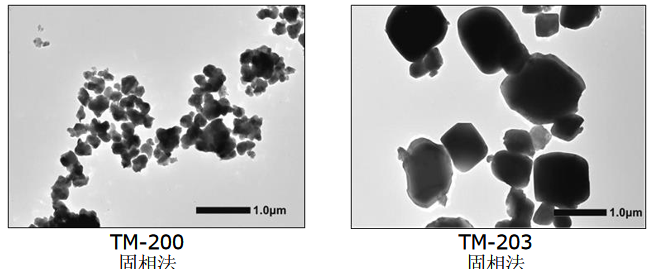
Magnesium Titanate TM Series
[Features]
●Medium Dielectric Constant
●Magnesium titanate particles synthesized by the solid-phase method; particle shape: granular
●Particle-size control: 0.3–0.8 μm
●Surface treatment with silane coupling agents and other materials is available.
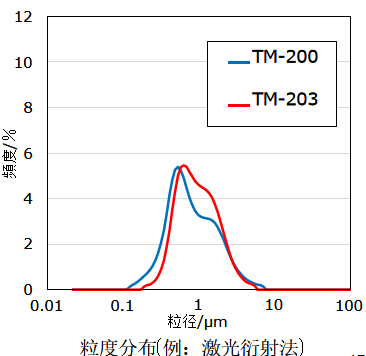
| Grade | Synthesis Method | Primary Particle Size (μm) | Average Secondary Particle Size (μm) | Specific Surface Area (m²/g) | Oil Absorption (g/100g) | Circularity | Specific Gravity (g/cm³) | Relative Dielectric Constant (Powder) |
|---|---|---|---|---|---|---|---|---|
| TM-200 | Solid-Phase Method | 0.3 | 0.6 | 5.6 | 33.4 | 0.76 | 3.7 | — |
| TM-203 | Solid-Phase Method | 0.8 | 1.0 | 2.5 | 11.9 | 0.79 | 3.7 | 14 |
| * Property values in the table are representative values. Relative dielectric constants were measured by the impedance method. | ||||||||
Magnesium Silicate (Forsterite) F Series
[Features]
●Low Dielectric Constant
●Granular samples manufactured by the solid-phase method
●Particle-size control: 0.1–1 μm
●Surface treatment with silane coupling agents and other materials is available.
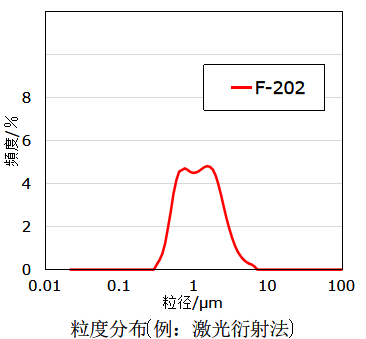
| Grade | Synthesis Method | Primary Particle Size (μm) | Average Secondary Particle Size (μm) | Specific Surface Area (m²/g) | Oil Absorption (g/100g) | Circularity | Specific Gravity (g/cm³) | Relative Dielectric Constant (Powder) |
|---|---|---|---|---|---|---|---|---|
| F-202 | Solid-Phase Method | 0.2 | 1.1 | 9.5 | 32.9 | 0.85 | 3.0 | 8 |
| * Property values in the table are representative values. Relative dielectric constants were measured by the impedance method. | ||||||||