


KESMON Deodorant
Features
☆ Inorganic chemical-adsorbent deodorant series
☆ Excellent heat resistance, allowing compounding into plastics
☆ Excellent immediate performance for rapid deodorization
☆ Reliable deodorization at low addition levels without releasing trapped odors
☆ High safety confirmed through various safety tests
☆ Extensive lineup for a wide range of everyday odors
Grades and Features
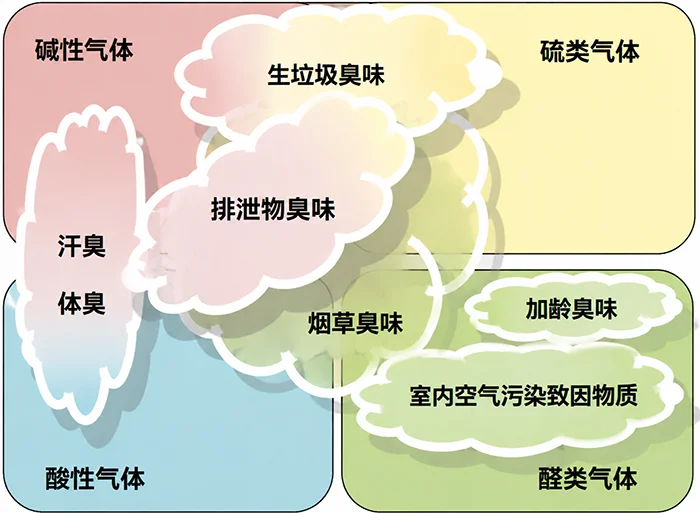
| Grade | Appearance | Average Particle Diameter (μm) | Target Gas (Deodorizing Capacity, mL/g) |
|---|---|---|---|
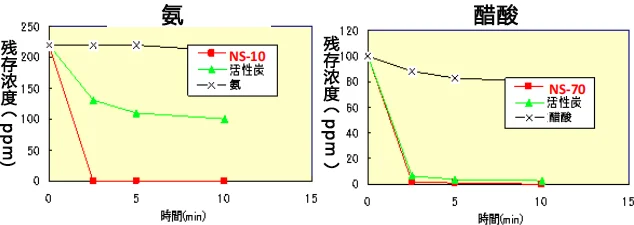
| NS-10 | White Powder | 1 | Ammonia (185), Trimethylamine (57) |
| NS-70 | White Powder | 6 | Acetic Acid (52) |
| NS-80E | White Powder | 2 | Acetic Acid (34) |
| NS-30N | Pale Yellow Powder | 2 | Hydrogen Sulfide (110), Methyl Mercaptan (9) |
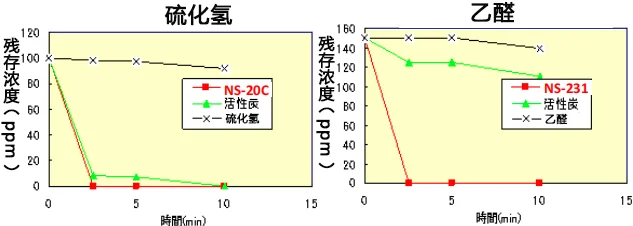
| NS-20C | Pale Blue Powder | 3 | Hydrogen Sulfide (237), Methyl Mercaptan (284) |
| NS-231 | White Powder | 5 | Acetaldehyde (50), Formaldehyde (80) |
| NS-750 | White Powder | 6 | Acetaldehyde (43), Formaldehyde (50) |
| NS-251 | White Powder | 3 | Acetaldehyde (48), Formaldehyde (81) |
| KS-730 | Translucent Liquid | 0.02 | Acetaldehyde (4) |
Mechanism of Action
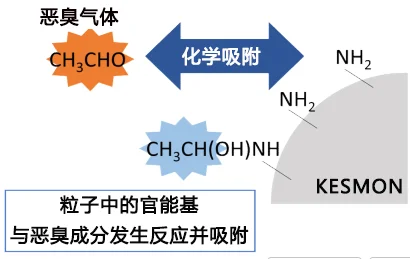
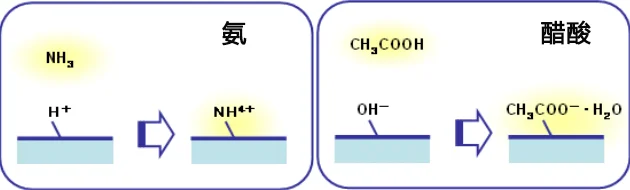
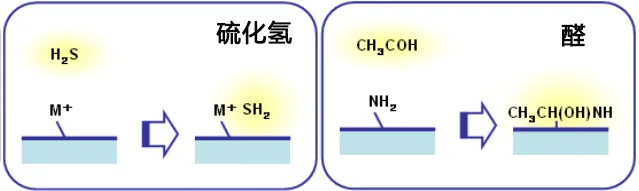
Functional groups in KESMON particles react with malodorous components to provide excellent deodorizing performance.。
Deodorizing Effect
Compared with activated carbon, KESMON deodorizes more rapidly and has a greater deodorizing capacity.
Examples
Processing Example: Surface Coating on Nonwoven Fabric
Coating various KESMON grades onto nonwoven fabric at 0.5 g/m² using a binder provides excellent deodorizing performance.
| KESMON | NS-10 | NS-231 | |
|---|---|---|---|
| Test Gas Initial Concentration | Ammonia 200ppm | Acetaldehyde | Formaldehyde |
| With KESMON | < 0.2 | < 1 | < 0.1 |
| Without KESMON | 35 | 15 | 23 |
| Blank Test | 180 | 33 | 31 |
Sensory Evaluation Example for Shoe Insoles
Processing various KESMON grades at 0.5 g/m² using a binder effectively removes odors inside shoes.
* Odor inside shoes is caused by lower fatty acids such as isovaleric acid and butyric acid, which are produced when skin bacteria break down secretions from the feet.
Sensory Test Method
Five subjects evaluated the odor inside their leather shoes after wearing them for one day. The table shows the number of subjects in each category.
| Almost No Odor | Slightly Unpleasant Odor | Very Unpleasant Odor | |
|---|---|---|---|
| NS-70 | 5 | 0 | 0 |
| NS-80E | 4 | 1 | 0 |
| Without KESMON KESMON | 0 | 0 | 5 |
Applications
| Textiles and Interiors | Clothing, Bedding, Masks, Sportswear, Curtains, Carpets, and Cushions |
| Daily Sundries and Home Appliances | Garbage Bags, Garbage Cans, Bathroom Furnishings, Bath Products, Air Purifiers, Kotatsu Heated Tables, Air Conditioners, and Refrigerators |
| Building Materials, Housing Equipment, and Furniture | Wallpaper, Flooring, Shoe Storage, Closets, and Dressers |
| Other | Car Seats, Coolers, Lunch Boxes, Disposable Absorbent Mats for Pets, Disposable Diapers, Feminine Hygiene Products, and Shoe Insoles |