


SR-K-230/231 Formaldehyde-Removal Material
Features
Fast Deodorizing Speed and Immediate Effect
High Deodorizing Capacity with Long-Lasting Performance
Excellent Performance against Basic Gases as well as Aldehyde Gases
Physical Properties
| Average Particle Diameter (μm) | Specific Gravity | Bulk Density (g/mL) | Heat Resistance | 5 wt% Dispersion pH | |
|---|---|---|---|---|---|
| SR-K-230 | 11 | 2.0 | 0.3 | 160°C | 4.2 ~ 5.2 |
| SR-K-231 | 5 | 2.0 | 0.2 | 160°C | 4.2 ~ 5.2 |
Deodorizing Performance
Deodorizing Speed
Place 0.1 g of test powder in a sealed container, inject 1 L of test gas, and measure the residual gas concentration using a detector tube.
Deodorizing Capacity (Acetaldehyde)
Deodorized Amount / Deodorization Rate |
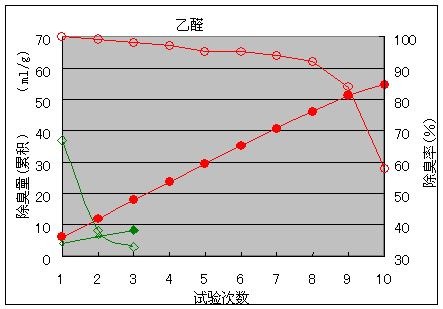
Place 0.1 g of SR-K-231 in a 1 m³ sealed container and inject 1 L of acetaldehyde gas at 600 ppm. After 2 hours, measure the residual gas concentration with a detector tube and repeat the test several times. Deodorizing capacity is calculated as the cumulative deodorized amount while the cumulative deodorization rate remains above 70%.
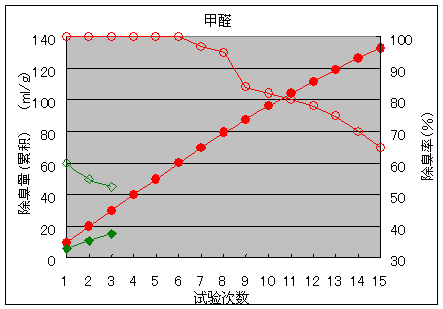
Deodorizing Capacity (Formaldehyde)
Deodorized Amount / Deodorization Rate |
Evaluation of Deodorizing Performance against Cigarette Smoke
Burn 20 cigarettes in a 1 m³ polypropylene box to prepare the test gas. Place 0.02 g of SR-K-231 in a sealed container and introduce 1 L of the test gas. After 30 minutes, measure the residual concentrations of acetaldehyde, ammonia, and acetic acid. Calculate the deodorization rate from the initial and residual concentrations, and calculate deodorizing capacity as the cumulative deodorized amount while the cumulative rate remains above 50%. Repeat the test with the same sample.
Desorption Test
Place 0.02 g of SR-K-231 in a 1 m³ sealed container, inject 1 L of acetaldehyde gas at 600 ppm, and leave for 2 hours at room temperature or 80°C. Calculate acetaldehyde adsorption (mL/g) from the residual gas concentration.
Then discharge all gas from the container, introduce 500 mL of fresh air, and leave at 80°C for 2 hours. Calculate acetaldehyde desorption (mL/g) from the measured gas concentration, and determine the desorption ratio relative to the adsorbed amount.
| Adsorbed at Room Temperature → Desorbed at 80°C | Adsorbed at 80°C → Desorbed at 80°C | |
|---|---|---|
| Adsorption at Room Temperature (mL/g) | 29.9 | 28.9 |
| Desorption at 80°C (mL/g) | 0.2 | 0.2 |
| Desorption at 80°C / Adsorption at Room Temperature | 0.7% | 0.7% |
Combined Use
1. Combined Use with Various Deodorants
Combining SR-K-230/231 with other deodorants enables removal of a wider range of odors.
To enhance the effect of SR-K-230/231 against aldehyde and basic gases, combine it with deodorants for sulfur and acidic gases to achieve broader malodor removal.
[Example of Combined Use with SR-K-230/231]
| Aldehyde Gases Ammonia | Aldehyde and Acidic Gases Ammonia and Sulfur Gases | |
| General Type | SR-K-230 | SR-K-230+SR-10N |
| Fine-Particle Type | SR-K-231 | SR-K-231+SR-10K |
2. Combined Use with Binders
SR-K-230/231 can be mixed with binders for nonwoven fabrics, fibers, and similar materials. However, some binders may reduce deodorizing performance or dispersibility, so conduct a preliminary test before use. Use a recommended binder that provides excellent deodorizing performance and dispersibility.
[Recommended Binders for SR-K-230/231]
Resin | Solids Content (wt%) | |
| KB-6202 | Acrylic | 45 |
| KB-3000 | Polyurethane | 30 |
3. Guidelines for Deodorant and Binder Addition Levels
The standard deodorant addition level is 0.5–3 g/m². Depending on the application, the recommended addition level for binder solids is generally equal to the deodorant amount, or 0.5–3 g/m².
Application Examples
Deodorizing Performance on Fibers
[Deodorant]
· SR-K-231
• SR-K-231/SR-10K Mixture: A blend of SR-K-231 with deodorants for acidic and sulfur gases
[Application to Fabric]
Polyester/Cotton = 65/35; Deodorant: 1 g/m²; Binder: 1 g/m²
[Evaluation Method]
Place the 10 cm × 10 cm fabric sample and each test gas—acetaldehyde (14 ppm, 3 L), ammonia (100 ppm, 3 L), acetic acid (50 ppm, 3 L), or hydrogen sulfide (50 ppm, 3 L)—in a sealed container. Measure the residual gas concentration after 2 hours.
| Residual Gas Concentration, ppm (Deodorization Rate, %) | ||||
|---|---|---|---|---|
| Acetaldehyde | Ammonia | Acetic Acid | Hydrogen Sulfide | |
| SR-K-231 | 3(79) | 1(99) | 10(80) | 3.5(13) |
| SR-K-231 Mixture | 4(71) | 2(98) | 3(94) | < 0.1(>98) |
Suppression of Formaldehyde Emissions from Composite Panels
[Deodorant]
· SR-K-231
• SR-K-231/SR-10K Mixture: A blend of SR-K-231 with deodorants for acidic and sulfur gases
[Application to Fabric]
Polyester/Cotton = 65/35; Deodorant: 1 g/m²; Binder: 1 g/m²
[Evaluation Method]
Place the 10 cm × 10 cm fabric sample and each test gas—acetaldehyde (14 ppm, 3 L), ammonia (100 ppm, 3 L), acetic acid (50 ppm, 3 L), or hydrogen sulfide (50 ppm, 3 L)—in a sealed container. Measure the residual gas concentration after 2 hours.
| Formaldehyde Concentration Absorbed in Purified Water (mg/L) | [For F☆☆☆☆ Surface Treatment] *1 Formaldehyde Emission (mg/L) | [Products Other than F☆☆☆☆] *2 Formaldehyde Emission (mg/L) | |
|---|---|---|---|
| SR-K-231 Applied at 1 g/m² | 0.64 | 0.28 | 0.17 |
| SR-K-231 Applied at 2 g/m² | 0.16 | 0.07 | 0.04 |
| Without SR-K-231 | 1.69 | 0.75 | 0.45 |
Precautions
• Contact between SR-K-230/231 and alkalis may cause discoloration and reduced deodorizing performance. Conduct a preliminary test before use.
• Adding a binder may reduce dispersibility. Use a binder recommended by our company.
• This product is a powder. Handle it in a draft-free area while wearing a protective mask, safety glasses, gloves, and other appropriate protective equipment.
• If the product enters the eyes, rinse with running water for 15 minutes and seek medical attention immediately.
• Wash affected skin with soap after contact.
• Use with care after thoroughly investigating all regulations relevant to each application of the deodorized product.
The information and data in this document are based on our test results and are not guaranteed values. To obtain optimum performance, conduct preliminary tests under the intended conditions of use.