


Microkiller® Inorganic Antibacterial Agent
Striving to set the global standard for functional materials
Our Brand
Microkiller®

Why Use an Inorganic Antibacterial Agent?
In general, inorganic antibacterial agents offer superior properties to organic antibacterial agents, most notably in the following two areas:
Excellent Safety
High Heat Resistance
Contains Antibacterial Metal Ions
Conventional glass consists of a network formed by cross-linking groups of network-forming ions with modifier ions. This robust network structure gives glass exceptionally high chemical stability.
Using proprietary processing technology, Microkiller adjusts the composition of its glass network to control the strength of that network. Antibacterial metal ions are incorporated into the structure to create a new, advanced glass material. As these metal ions are released gradually, the glass provides effective, sustained inhibition of bacterial growth.
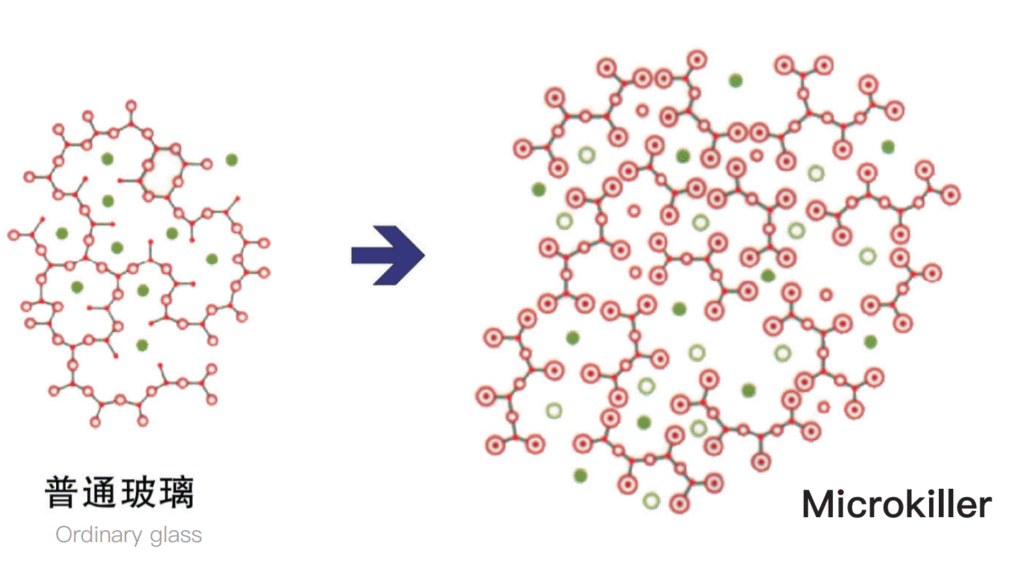
Mechanism of Antibacterial Action
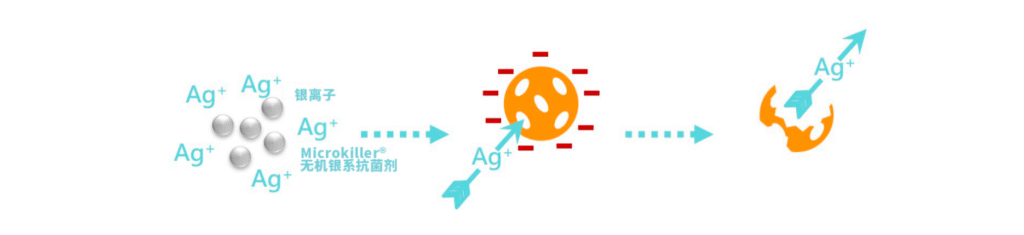
Positively charged metal ions released by the Microkiller® inorganic antibacterial agent are adsorbed onto the surface of bacterial cell walls. They then disrupt the bacteria’s electrolyte balance, ultimately causing cell death.
Product Advantages


Test Results
General Plastics
| Test Strain | Mean log bacterial count recovered after different contact times (cfu/cm²) | Antibacterial Activity Value | Antibacterial Rate (%) | ||
|---|---|---|---|---|---|
| / | 0h | 24h | |||
|
Escherichia coli E. coli ATCC 8739 | Control Blank | 1.0×10⁴ | 4.8×10⁵ | >5.9 | >99.9 |
| Antibacterial Sample Experimental group | 1.0×10⁴ | <0.63 | |||
|
Staphylococcus aureus Staph. aureus ATCC 6538P | Control Blank | 1.8×10⁴ | 1.6×10⁵ | >5.4 | >99.9 |
| Antibacterial Sample Experimental group | 1.8×10⁴ | <0.63 | |||
| Test Method: ISO 22196 | |||||
Engineering Plastics
| Test Strain | Mean log bacterial count recovered after different contact times (cfu/cm²) | Antibacterial Activity Value | Antibacterial Rate (%) | ||
|---|---|---|---|---|---|
| / | 0h | 24h | |||
|
Escherichia coli E. coli ATCC 8739 | Control Blank | 1.8×10⁴ | 1.6×10⁵ | >5.4 | >99.9 |
| Antibacterial Sample Experimental group | 1.8×10⁴ | <0.63 | |||
|
Staphylococcus aureus Staph. aureus ATCC 6538P | Control Blank | 1.8×10⁴ | 1.6×10⁵ | >5.4 | >99.9 |
| Antibacterial Sample Experimental group | 1.8×10⁴ | <0.63 | |||
| Test Method: ISO 22196 | |||||
Models
| Model | Type | Mean Particle Size (μm) |
|---|---|---|
| MK-T-101 | Silver-Based Antibacterial Agent | 10 |
| MK-T-110 | Silver-Based Antibacterial Agent | 50 |
| MK-T-111 | Silver-Based Antibacterial Agent | 2 |
| MK-T-112 | Silver-Zinc Antibacterial Agent | 2.6 |
| SR-T-104 | Silver-Based Antibacterial Agent | 10 |
| SR-FB-201F | Silver-Based Antibacterial Agent | 1 |
| SR-T-801 | Silver-Based Antibacterial Agent | 5 |